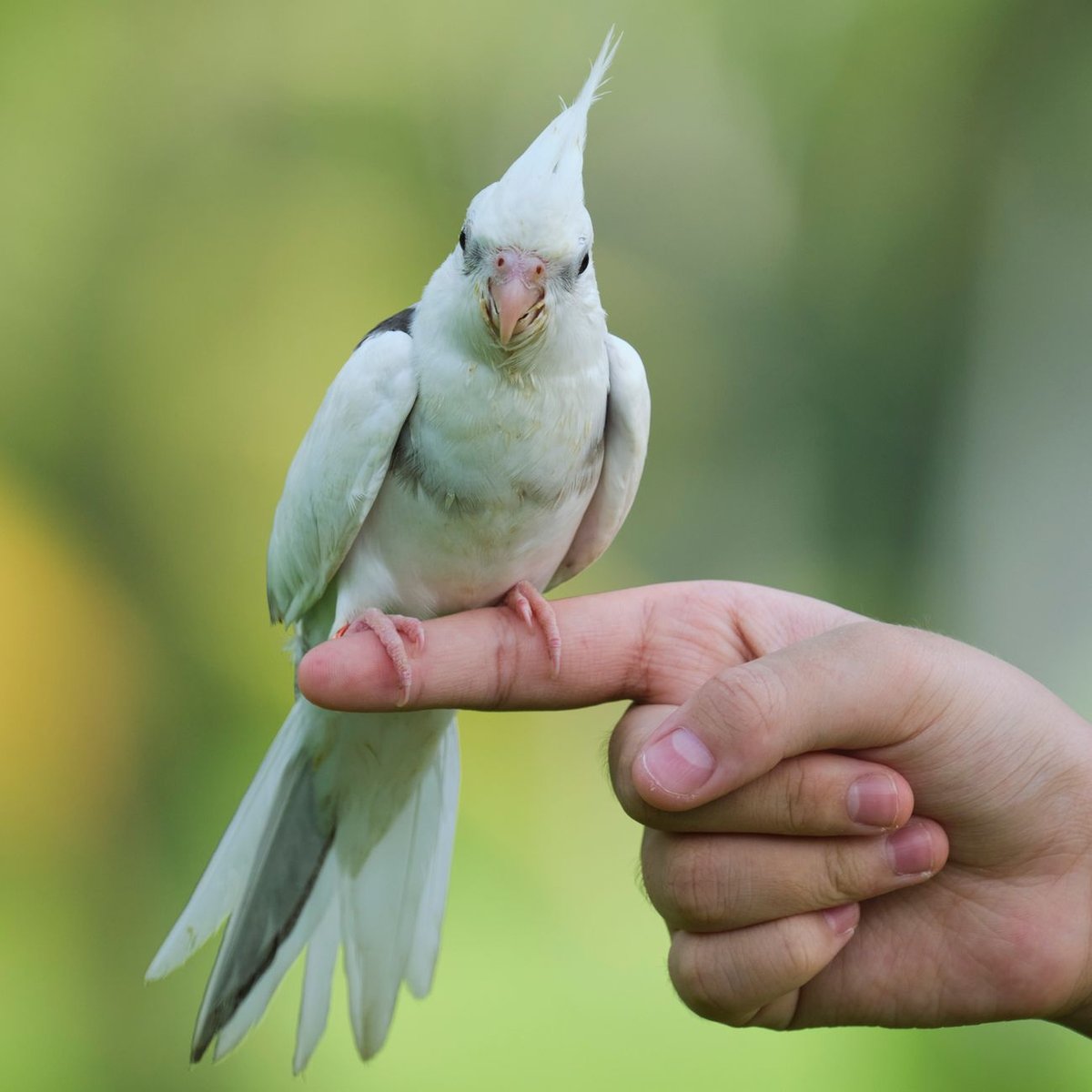
Quick answer: almost any cockatiel can be tamed, including older and rehomed birds. The process runs on the bird’s clock, not yours - typically two to eight weeks from nervous to stepping up reliably. The sequence never changes: let the bird get used to your presence, make your hand the thing that brings millet, then teach step up. Skipping ahead is the single most common reason taming stalls.
What the timeline actually looks like
Every bird moves at its own pace. A hand-reared youngster may run through this in a fortnight; a rehomed adult with a bad history can take months. Use this as a map, not a schedule.
| Stage | What you do | Move on when… |
|---|---|---|
| 1. Settle in Days 1-7 | Nothing. Feed, change water, leave the bird alone. | The bird eats, preens and calls normally while you’re in the room. |
| 2. Habituation Week 1-2 | Sit near the cage 20 minutes a day, talking softly. | The bird stops freezing when you approach and carries on eating. |
| 3. Treats through the bars Week 2-3 | Offer millet through the cage bars, hand still. | The bird takes millet without hesitating. |
| 4. Hand inside the cage Week 3-4 | Rest your hand inside, motionless, millet in fingers. | The bird approaches and eats with your hand in the cage. |
| 5. Step up Week 4-6 | Finger just above the feet, gentle pressure to the chest. | The bird steps up with both feet on request. |
| 6. Out of the cage Week 6+ | Short supervised sessions in a bird-safe room. | Ongoing - this is the relationship, not a finish line. |
If a stage goes backwards, drop to the previous one for a few days. Pushing through fear teaches your bird that hands are something to escape.
Before you start: set the cage up right
Taming is much harder in a cage that keeps the bird on edge. Get this right first and a lot of “nervous bird” problems disappear on their own.
- One side against a wall or in a corner. A cage floating in open space leaves a prey animal with nowhere that feels safe at its back.
- Roughly at your eye level. Looming over a bird from above reads as a predator; a cage on the floor makes every approach a looming one.
- In a room the family uses, but out of the traffic lane. You want your bird accustomed to normal household life, not startled by people brushing past the bars.
- Away from draughts, direct sun and the kitchen. Cooking fumes are a genuine hazard - see cockatiel breathing problems.
- Varied perches at different heights and thicknesses. Good for foot health, and a bird that can choose its height feels more in control.

- STURDY CONSTRUCTION - Made of the highest-quality iron frame with a black powder varnish guaranteed to make this birdcage sturdy and durable, even against playful birds; With 4 caster wheels at the bottom, so you can move it anywhere you like, saving you effort
- MULTIPLE DOORWAYS - Designed with 2 doorways for your pet birds to enter and exit; The top of the cage opens up and can be propped open with a wooden crossbeam for your birds to stand on; Traditional doors are located on the side of the cage
- SLIDE-OUT TRAY - Equipped with a plastic tray at the bottom of this bird cage that can be removed for easy cleaning, so as to keep a clean and tidy environment as well as keep your pets safe
- VARIOUS WAYS TO PLAY - Includes a swing and multiple bars to stand on; Convenient doors so you can change the food without disturbing your pets; Locking joints to keep the cage secure; With little design features that stand out among the crowd
- EXTRA STORAGE SPACE - Comes with an additional mesh shelf so you can store food and toys out of the way; Provided with a wealth of accessories, including 4 Wooded perches, 4 Feeding cups, and 1 swing
Week one: do almost nothing
This is the step everyone skips, and it’s the one that decides how the rest goes. A newly homed cockatiel has lost its flock, its territory and every familiar sound in one afternoon. For the first week, restrict yourself to food, water and cage cleaning. No handling, no reaching in, no standing over the cage.
What you are doing in that week is habituation - the technique field researchers use with wild birds. Simply be present without anything bad happening. Sit within sight of the cage for twenty minutes a day doing something passive: reading, working on a laptop, watching television at low volume. Talk quietly, narrate what you’re doing, keep your voice level. You are teaching one lesson only: this large animal turns up, nothing bad happens, it leaves.
Reading your cockatiel before you touch it
Every taming decision comes down to one question: is the bird comfortable or is it frightened? Learn these and you’ll know when to advance and when to hold.
| Settled - go ahead | Frightened - back off |
|---|---|
| Eating, preening or chirping while you’re there | Freezing, going silent, stopping mid-meal |
| Crest held loosely upright or relaxed back | Crest pinned flat against the head |
| Beak grinding, gentle chatter, one foot tucked | Hissing, open beak, lunging at your hand |
| Feathers loose and relaxed | Feathers pressed tight, body slimmed, eyes wide |
| Moving towards your side of the cage | Retreating to the far corner or flapping wildly |
One correction worth making, because it circulates widely: beak grinding is a contentment sound, usually made just before sleep. It is not a stress signal. A slimmed-down body with tight feathers and wide eyes is the fear posture - the opposite of the relaxed, fluffed bird. The full vocabulary is in our cockatiel behaviour guide.
One more thing to rule out early: a bird that stays hunched, puffed and disengaged isn’t shy, it’s unwell. Check it against the sick bird look before assuming a taming problem, and book a new-bird check with an avian vet.
The treat ladder: millet is your currency
Millet spray is the single most useful taming tool there is - very few cockatiels can refuse it. That also makes it a diagnostic: a bird that won’t take millet from a still hand is either not ready or not well.
- Millet in the dish, while you sit nearby. The bird eats a treat in your presence.
- Millet clipped to the bars on your side of the cage. The bird comes to your side voluntarily.
- Millet held through the bars. Keep your hand completely still and look slightly away - a direct stare is predator behaviour.
- Hand resting inside the cage, millet in your fingers, motionless. This can take several sessions. Let the bird come to you.
- Bird eats from your open palm. At this point the hand has become a good thing, and step up is close.
Keep treats small and ration them - millet is fattening, and an unlimited supply stops it being special. See can a cockatiel eat too much millet? Sunflower seeds work as a high-value reward for the same reason, and carry the same caution. For everything else that’s safe to offer, use the food safety list.
Teaching step up
“Step up” is the foundation of everything else - handling, vet visits, getting your bird out of trouble. Once your cockatiel eats calmly from your hand, you’re ready.
- Hold a finger horizontally just above the bird’s feet and press very gently against the lower chest. Cockatiels instinctively climb upward, and the pressure makes stepping up the easiest option.
- Say “step up” every single time, in the same tone. The words matter less than the consistency.
- One foot is a win. Most birds test with a single foot for several sessions before committing. Reward it.
- Reward immediately with millet and quiet praise, then let the bird step back off. Ending on a good moment matters more than lasting longer.
- Practise inside the cage first, moving the bird a short distance perch to perch.
If your bird lunges or bites at your finger, swap to a wooden dowel or a spare perch for a few weeks. There’s no shame in it - a dowel gets an untamed bird stepping up reliably without either of you getting hurt, and you transition to fingers later.

- SizeLadder shelf 7.48 x 7.48″ / 19 x 19cm.
- Safe Material This bird corner perch is made of natural wood, non-toxic and harmless, pets can chew and bite safely, safely grinding teeth and trim beak and nails naturally, the perch surface polished smooth, will not hurt the pet feet.
- FeatureThe smooth and polished bird stand is made of solid materials, and the metal nut is more stable, which is convenient to install in any corner of the cage and increases the pet’s activity space.
- Multi-FunctionThe playground for birds and parrots, the platform for resting, and the smooth surface protect the feet, making it a stable and safe landing site.
- Best GiftThis bird perch provides your pet with a nice and cozy place for playing, exercise and rest, relieves boredom and increases activity level, this is the perfect gift for pets.
Coming out of the cage
Only once step up is reliable. Before the door opens, make the room safe: windows and mirrors covered, ceiling fans off, other pets out, doors shut, no open water, no non-stick pans heating anywhere in the house.
Expect the first flight to be clumsy - a bird that hasn’t flown in a while has no stamina and poor landing accuracy. Keep sessions short. To return the bird, use your finger as the perch rather than herding or grabbing; being caught by hand undoes weeks of work. If it does go wrong, how to catch a cockatiel covers doing it calmly.
How to run a session
- Short and frequent beats long and occasional. Five to ten minutes, twice a day, is far more effective than one long weekly session.
- Same time each day. Cockatiels are creatures of routine, and predictability is calming in itself.
- Train when the bird is keen, not full. Before a meal, not after.
- Finish on a success. Stop while it’s still going well rather than pushing until it fails.
- Protect sleep. An overtired bird is a reactive bird - cockatiels need 10-12 hours of dark, quiet rest. See how much sleep do cockatiels need?
When your bird bites
Biting is almost always fear or a boundary being pushed, not malice. The response that works is boring: stay still, don’t jerk your hand away, put the bird down calmly, and end the session without drama. A dramatic reaction - yelping, flapping, chasing - is interesting, and interesting things get repeated.
Do not punish a cockatiel. No shouting, no cage rattling, no flicking the beak, no blowing in the bird’s face, and never “drop” the bird off your hand. Punishment doesn’t teach a prey animal what to do differently - it only teaches that hands are unpredictable, which is precisely the belief you’re trying to undo.
Instead, work out what triggered it. Common causes: reaching into the cage (territorial), touching the back or tail (a mating cue - see where not to touch a cockatiel), hormonal season, or moving too fast for the stage you’re at. Gentle beak contact is usually not biting at all - see why does my cockatiel nibble me? For a persistent biter, what to do if your cockatiel bites you goes deeper, and how to discipline a cockatiel covers redirecting unwanted behaviour without punishment.
Setbacks are normal
Nearly every bird regresses at some point - suddenly refusing to step up, retreating, going quiet. It’s rarely about you. Look for what changed: a new person in the house, rearranged furniture or cage layout, a different work schedule, building noise outside, a new pet, or moulting, which makes birds irritable and touchy for weeks.
Remove the stressor if you can, then drop back one stage on the ladder for a few days and rebuild. Progress after a setback is usually much faster than the first time through.
Taming an older or rehomed cockatiel
Yes, an older cockatiel can absolutely be tamed. Age itself is not the obstacle - history is. Three things shape how long it takes:
- Previous handling. A bird that was handled kindly, even years ago, often comes around quickly. One that was grabbed, chased or left alone in a garage will need considerably longer.
- Socialisation. A bird exposed to household noise, different people and other animals adapts faster than one kept in isolation.
- Health. An unwell or underweight bird has nothing spare for learning. Get a vet check before you write off a bird as untameable.
The method is identical - the same ladder, just with longer pauses on each rung. What differs is your expectations. An older bird may never become a shoulder-riding cuddler, and that’s a legitimate outcome. A rehomed cockatiel that reliably steps up, takes treats and stays calm around you is a well-adjusted bird, whether or not it wants to be petted.
Why won’t my cockatiel step onto my finger?
| Likely cause | What to do |
|---|---|
| Still afraid of hands | Go back to the treat ladder. You’ve moved ahead of the bird. |
| Never learned the cue | Practise inside the cage, short sessions, always the same words. |
| Finger is unstable | Hold it rigid. A wobbling perch is an unsafe perch. |
| Bad past experience | Switch to a dowel for a few weeks and rebuild from there. |
| Independent personality | Some birds simply prefer not to be handled. Respect it. |
| Unwell | Check for other symptoms and see an avian vet. |
| Hormonal season | Expect regression in spring; hold steady, don’t push. |
Frequently asked questions
How long does it take to tame a cockatiel?
Two to eight weeks for most birds to reach reliable step up. Hand-reared youngsters can take a fortnight; rehomed adults with a difficult history sometimes take several months. The bird sets the pace.
Should I clip my bird’s wings to make taming easier?
It’s a contested topic and not a shortcut. Clipping removes a frightened bird’s only escape option, which can make a nervous bird more defensive rather than less. Plenty of cockatiels are tamed fully flighted. If you’re considering it, discuss it with an avian vet rather than doing it to speed up training.
Can I tame two cockatiels at once?
It’s slower. Birds bonded to each other have less need of you, and a nervous bird will copy its companion’s alarm. Where possible, run short one-to-one sessions in a separate room, then return the bird to its companion.
My cockatiel was tame and has suddenly become standoffish. Why?
Most often moulting, hormonal season, or a change in the household. Check for illness first, then look for what’s changed in the environment, and drop back a stage until confidence returns.
Do cockatiels bond to one person only?
They often form a strongest bond with whoever spends the most time with them, but they can be comfortable with a whole household. The fix is simple: have everyone do short sessions and hand out treats, so the bird doesn’t associate good things with one pair of hands.
Next steps
Once step up is solid, the interesting part starts. Recall training teaches your bird to fly to you on cue, and redirecting unwanted behaviour keeps a confident bird from becoming a demanding one.